Tuesday, June 4, 2013
BMW Motorcycle History

- 1913 : Bayerische Motoren Werke is incorporated. The company produces aircraft engines.
- 1918 : The Prussian army orders 2,000 BMW model IIIa aircraft engines
- 1919 : A plane powered by an updated model IV engine sets an altitude record at over 32,000 feet. Just a few weeks later, the Treaty of Versailles is signed and Germany is forbidden to manufacture airplanes. BMW turns its focus to motorcycles.
- 1920 : The 2-stroke 148cc Kurier motor is developed.
- 1921 : The M2 B15 is developed. It’s BMW’s first flat-Twin – aka ‘Boxer’ – motorcycle. The motor is based on an earlier aircraft design.
- 1922 : The first light-alloy cylinder head is developed.
- 1923 : Legendary BMW designer Max Friz sequesters himself in his house and draws the plans for an all-new motorcycle. The 486cc R 32 is shown at the Paris “Salon.” It is a big improvement over the M2 B15 and reaches a top speed of about 60 mph.
- 1925 : A racing version of the R 32 – the R 37 – is introduced. Also, the R 39 debuts and front brakes are added to the R 32.
- 1927 : BMW develops the R 47, which would go on to replace the R 32, R 37 and R 39.
- 1928 : BMW releases its biggest motorcycle to date – the 750cc R 62, with a top speed of 71 mph.
- 1929 : Paul Köppen wins the 500cc class at the famed Targa Florio road race in Sicily. BMW will win the next two years’ races, as well. Ernst Henne uses a supercharged, 750cc “kompressor” (supercharged) on a closed stretch of Autobahn to set a new land-speed record of over 134 mph.
- 1930 : An economic downturn in Germany leads BMW to produce a smaller bike, the 198cc R 2. This commuter bike was the first to use a one-piece ‘tunnel’ crankcase. Smaller motorcycles (under 200cc) did not require licenses in Germany, and the R 2 went on to sell more than 15,000 units.
- 1932 : The R 4, with a 398cc single-cylinder overhead-valve engine, is released.
- 1933 : The German army commissions BMW to produce R 4s, helping the company to stay in business despite the Great Depression.
- 1935 : The 745cc R 12 is introduced. It is the first production model with hydraulically dampened front forks.
- 1936 : The R 5 is introduced, which is BMW’s first bike with rear-plunger suspension. Also, the 500cc R 7 is released, which can reach 87 mph. Otto Ley wins the Swedish 500cc Grand Prix on another “kompressor.” The supercharged BMWs will be the dominant force in Grand Prix racing until WWII. (After the war, the FIM bans forced-induction motors. Some people interpret the rule as punishing the Axis, since the most successful supercharged racing motorcycles were German and Italian. The single-cylinder bikes favored by British manufacturers were conventionally aspirated.)
- 1937 : A Bavarian motorcycle cop and off-road racer, Georg Meier, tries a BMW road racer and pulls off after a few laps, saying he’s afraid to go fast.
- 1938 : Beginning with the R 61, BMW has introduced rear suspension on all production models. Six new models are introduced this year, including the R 23, R 51, R 66 and R 71. The R 71 is the last BMW bike to feature a side-valve engine.
- 1939 : Georg Meier wins the Isle of Man Senior TT on a BMW. With the start of World War II, BMW turns its attention back to airplane production.
- 1941 : BMW introduces the R 75, which was designed for war use. Weighing a whopping 925 pounds, the R 75 featured 750 cc engine, large gas tank, two seats and a sidecar. It could also be fitted with a machine gun. The U.S. Army is impressed with the R 75 and similar Zundapp models. Captured German bikes are sent back for Harley-Davidson and Indian to copy. Up to 1,000 prototypes are built, but those motorcycles never see action.
- 1946 : With the war over, BMW is forbidden to manufacturer motorcycles and turns its attention to making bicycles. To add insult to injury, German patents are taken in war reparation, and the French company CMR (later known as Ratier) begins making a BMW clone.
- 1948 : BMW begins motorcycle manufacturing again with the R 24. The company’s first post-war bike, the R 24 is powered by a 250cc engine, the maximum allowed at the time.
- 1949 : BMW introduces the R 50/2 and R 51/2. Both are seen as inferior as the main rear bearing had been moved into the crankcase and needed to be replaced every 10,000 miles.
- 1950 : The R 25 with plunging rear suspension is introduced.
- 1952 : BMW produces the 600cc R 67, outfitted with a sidecar.
- 1953 : BMW begins production of the RS Series, which features a swinging arm rear suspension and Earles forks. Also, the R 25 is redesigned and released as the R 25/3. The RS54 Rennsport production racer is unveiled.
- 1954 : The team of Wilhelm Noll and Fritz Kron win the sidecar World Championship. Their victory marks the start of an incredible run; BMWs will win 19 of the next 21 world titles!
- 1955 : The R 50, which also features a rear swingarm and leading-link front fork, replaces the R 51/3.
- 1956 : Walter Zeller finished second in the 500cc World Championship, behind John Surtees; it is BMW’s best “solo” result in the modern era.
- 1957 : Motorcycle production falls from 23,531 in 1955 to just 5,429 in 1959 due to an economic decline.
- 1960 : The classic R 69 S is introduced. It is the fastest Boxer available at the time, reaching a top speed of 109 mph. Also, the R 27 is released, which features a rubber-mounted engine to cut down on vibration.
- 1967 : Special United States export versions of the R 60 and R 69 are built, but no new models are released from 1961 through 1968.
- 1969 : The /5 Series is launched and features electric starters. The R 50/5, R 60/5 and R 75/5 are all released with telescoping front forks.
- 1973 : BMW celebrates its 50th anniversary and the 500,000th BMW motorcycle rolls off the line. The R 90 S is released, featuring a 900cc engine. The /6 Series is also introduced, with 600, 700 and 900cc variations.
- 1974 : For the first time, BMW offers five-speed gearboxes on production motorcycles.
- 1976 : BMW introduces the /7 1000cc R 100/7. The R 100 RS is also released, featuring the same 1000cc engine and a top speed of 125 mph. It is the first production bike to feature a full fairing. Helmut Dähne wins the Isle of Man Production (1000cc) TT. Reg Pridmore becomes the first-ever winner of the AMA “Production Superbike” championship, on an Udo Geitl-tuned R90S entered by Butler & Smith, the U.S. BMW importer.
- 1977 : The R80/7 is introduced and becomes a favorite of police forces.
- 1978 : The luxury-touring R100RT is introduced and features a full-touring fairing. The 473cc R 45 is also introduced.
- 1980 : The 800cc R80G/S is introduced, which features a single-sided swingarm. The initials stand for Gelände/Strasse, which is “offroad and street” in German.
- 1981 : Hubert Auriol wins the third edition of the Paris-Dakar race on an R80G/S prepared by HPN, a German specialist tuner that is still in the business of equipping BMWs for rough country.
- 1982 : BMW introduces a road version of the R80G/S – the R80RT.
- 1983 : The K100 is introduced – the first of the water-cooled K series. It is the first production bike with electronic ignition and fuel injection and has a top speed of 132 mph. A racing version called the K100RS is also introduced.
- 1985 : BMW designs its first three-cylinder motorcycle – the K75. This bike shares much in common with the K100 but consumes less fuel and is has more nimble handling.
- 1986 : BMW re-launches the R100RS with Monolever rear suspension and a 60 hp engine.
- 1987 : The R100RT is re-launched with Monolever rear suspension and a smaller engine. BMW also debuts its double-jointed single-sided swingarm Paralever system this year. The 1000cc K100LT luxury cruiser is also introduced.
- 1988 : The R100G/S goes into production and is known as the ‘largest dirt bike in the world’ thanks to its 463-pound weight.
- 1989 : The K1 goes into production. At the time, BMW was obeying a voluntary 100-hp limit on engine power. In order to maximize performance without exceeding that limit, the designers create a striking, all-encompassing aerodynamic body that allows the 600+ pound machine to reach 140+ mph. It features the first ever digital engine electronics system on a production bike. It’s far too strange for BMW’s (then) conservative riders, and as a result it will be was discontinued after a few years of underwhelming sales.
- 1990 : A four-valve version of the K100RS is introduced. ABS is now standard on all K series bikes.
- 1991 : The 1,000,000th BMW motorcycle is produced – a three-cylinder K75RT. BMW begins outfitting its motorcycles with three-way catalytic converters. BMW also re-releases its R100R.
- 1993 : The R1100RS sports tourer is introduced. The bike is powered by a fuel-injected, eight valve, twin-cylinder engine.
- 1994 : BMW’s first single is released in 30 years, the F650 Funduro, plus the first four-valve GS, the R1100GS.
- 1995 : This is the last year that the two-valve traditional Boxer is produced.
- 1996 : The powerful four-cylinder, liquid-cooled K1200RS is introduced.
- 1997 : BMW introduces its first chopper/cruiser – the R1200C. It’s the choice of James Bond, but that’s not enough to make it very popular. It will be discontinued a few years later.
- 1999 : Richard Sainct wins the Paris-Dakar on a race-tuned 650cc single-cylinder “Funduro.” Officially, the bike’s designated the F650RR. The only stock part on the entire machine is the taillight!
- 2000 : BMW releases its R1150GS, as well as a new luxury-tourer, the K1200LT.
- 2004 : An all-new, lighter and more powerful Boxer Twin motor equips the R1200GS. The K1200S is a radical new machine for the venerable manufacturer. It features an across-the-frame four-cylinder motor making a claimed 167 horsepower. It is the first time in years that BMW has shown a willingness to compete head-to-head in the marketplace with the world’s biggest motorcycle companies.
- 2007 : The company leaks news of the S1000RR, a four-cylinder literbike that it plans to race in the 2009 World Superbike Championship.


Thursday, May 23, 2013


Wednesday, May 22, 2013
2012 BMW R1200GS Adventure Triple Black
 |
| 2012 BMW R1200GS Adventure Triple Black |
 |
| 2012 BMW R1200GS Adventure Triple Black |
MSRP Price: £11,730.
ENGINE
- Type: Flat Twin
- Cylinders: 2
- Displacement (cc): 1170
- Horsepower (bhp): 110 bhp
- Torque (Ft Lbs): 88 lbs
- Redline RPM: N/A RPM
- Body Material: Plastic
- Frame: Aluminum / Steel
- Hand Grip Material: N/A
- Number Of Speeds: 6
- Transmission Brands: N/A
- Transmission Types: Manual
- Speedometer: Standard
- Tachometer: Standard
- Fuel Level Warning: Standard
- Rear Wheel Diameter: 17
- Front Wheel Width (in): 2.5
- Rear Wheel Width (in): 4
- Tank Bag: N/A
- Saddle Bag(s): Not Available
- Lockable Storage: N/A
- Front Tire Speed Rating: H
- Rear Tire Speed Rating: H
- Tire Brand: N/A
- US MPG (City): N/A
- US MPG (Combined): N/A
- US MPG (Hwy): 51
- Front Caliper Pistons: N/A
- Rear Caliper Pistons: N/A
- Rear Brake Rotor Width (mm): N/A
- Front Suspension Brand: Telelever
- Front Suspension Type: Telescopic Fork
- Rear Suspension Type: Single Sided Swing Arm
- Seat Height (mm): 890
- Seat Material: Vinyl
- Seat Type: Two-Piece
- Fuel Capacity (gal): 8.7
- Number Of Speakers: N/A
- Adjustable Handlebars: Standard
Saturday, May 18, 2013
BMW C 650 GT 2012


2009 BMW K Series to 1300cc
 BMW K1000S
The K1300S benefits from 136cc more power, with BMWs other superbike cranking out 175 horsepower.
 BMW K1000R
The distinctive front end of the K1300R defines the naked version of BMWs revamped K series.
 BMW K1000GT
source : http://www.motorcycle-usa.com/354/1260/Motorcycle-Article/2009-BMW-K-Series-Goes-to-1300.aspx
Thursday, May 16, 2013
Will introduce BMW C Evolution

The BMW Motorrad introduces an exciting electric scooter, scooter question is the BMW C Evolution. This scooter first appeared on the show BMW Motorrad Innovation Day 2011.
The BMW C Evolution is supported by the hybrid composite structure that can output power 15 Hp up to 47 Hp, and able to spend up to a maximum speed of 120 kph. The C Evolution is also supported by the engine of the swing arm, and the battery casing behind the alternator that is integrated with the swing arm.
BMW C Evolution can cover a distance of up to 100 km with the support 8kWh battery, the battery can be recharged through a charging device that is integrated with regular sockets in 3 hours. C evolution also has been strengthened with a feature that can restore the energy that has been issued by braking or sliding without gas withdrawn, and according to the news BMW C Evolution will be ready for sale in 2014.
Corrections on a previous BMW Airheads post
 From Left - 2000 K1200LT, 1975 R90S, 1973 R75/5
Mr. Greg Shamieh actually wrote to me on April 27 regarding a post on the BMW Airheads.
Nice to see you providing some coverage to the classic airhead BMW motorcycles. As the picture above indicates, I know a little about them…those are my three bikes… the /5 in the foreground was my daily transport from 1980 to 1995…it has 170,000 miles on it – 150,000 of which I put on it. I am also a sometime moto-writer with some ‘Motorcyclist’ and web feature bylines to my credit.
Enthusiastic though you may be, your article is riddled with opinions masquerading as facts, several of which are demonstrably incorrect.
“No more shaft drives and no more bone crunching kick starts.” – sorry, but wrong on both point. Shaft drive continued to be a BMW requirement up until the rotax engine singles in the F650 series. (Yes, the shaft drive was definitely an oversight on my part).
Your analysis of both the long wheelbase and toaster tanks are both completely off base. The lengthening of the wheelbase was not a US only change … it was caused because with worn tires the bikes demonstrated some marked instability that was killing off potential customers. people with surviving SWB models know to keep the tires, wheel bearings and steering head adjustments well tended to …or else! And the toaster tank, far from being an enlongated touring tank, is actually marginally shorter and much smaller fuel capacity – 5 gal compared to 6.5 for the regular’ kneepad’ tank - making it utterly useless in a touring context. The whole ‘toaster’ exercise was a one year only, US only styling experiment that at least at the time, was a miserable, commercial failure. Some of these tanks did end up on other bikes, either through parts swapping or the aftermarket, but it is only in retrospect that these bikes have become desirable.
Monday, May 13, 2013
New 2013 BMW HP4 Bikes Prices Spcifications and Pictures
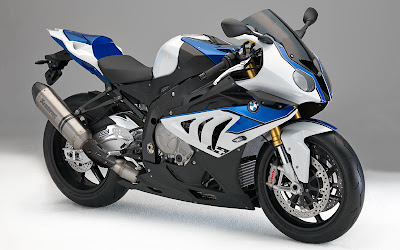
The New BMw 193bhp standard HP4 2013 is priced at £ 16,700 OTR while the Carbon version will cost £ 19,350 OTR.The New 2013 BMW HP4 Bikes are based S1000RR Superbikes.The 2013 BMW S1000RR HP4 come with prices starting at $ 19,990 for the base model to $ 24,995 for the premium package (a destination charge of $ 495 is added to each bike sold in the United States).
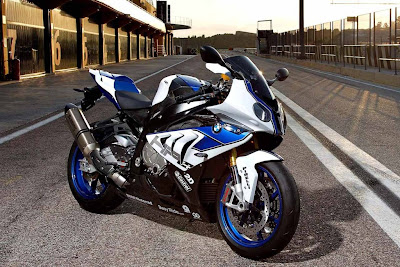 |
| The New 2013 BMW HP4 Bike carbon edition features a wide variety of carbon fiber parts and accessoriesaddition to the standard model.2013 The BMW S1000RR engine specifications are the same if HP4 provides the full output of 193 hp at 13,000 rpm and 112 Nm of torque at 9750 rpm. |
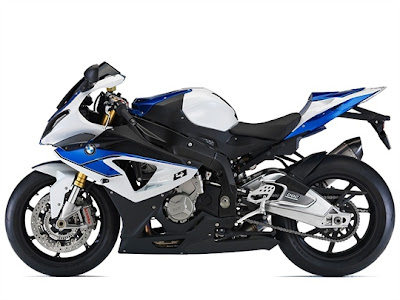 |
| New 2013 BMW S1000RR HP4 Picture |
• Semi-active suspension - Dynamic Damping Control DDC.
• IDM developed Race ABS.
• Dynamic Traction Control DTC with fine adjustment in "Slick" mode.
• HP Gear Shift Assist as standard.
• Lightweight titanium exhaust system.
• Launch Control with refined wheelie detection.
• Lightweight forged aluminium wheels in black.
• Radially-mounted Brembo monobloc brake callipers.
• LED indicators.
• Tinted windshield.
• Rear wheel tyre in size 200/55 ZR 17.
• Top yoke with engraved number and HP4 logo.
 |
| New 2013 BMW S1000RR HP4 |
• HP brake & clutch lever.
• HP carbon belly pan.
• HP rider footrest system.
• Wheels in Racing Blue metallic.
• HP carbon badge carrier.
• HP carbon tank cover & numberplate hanger.
• Sponsor sticker kit included.
The Premium Package ($24,995) and Optional extras: Heated grips ($250) & an anti-theft alarm ($395)
- All base model items
- Competition Package (individually priced at $4,470):
- HP carbon engine spoiler
- HP carbon trim
- HP folding clutch and brake levers
- HP rider footrests – adjustable
- Forged aluminum wheels in Racing Blue Metallic
- Sponsor decal kit (not mounted)
- Pillion Rider Package (described above)
- Heated Grips
BMW K 1600 GTL Specifications

BMW K 1600 GTL Specifications
Engine
- Type : Oil-/watercooled 4-stroke in-line 6-cylinder engine, two overhead camshafts, four valves per cylinder
- Bore x stroke : 72 mm x 67,5 mm
- Capacity : 1.649 cc
- Rated output : 118 kw at 7.750 rpm
- Max. torque : 175 Nm at 5.250 rpm
- Compression ratio : 12,2 : 1
- Mixture control / engine management Electronic intake pipe injection, digital engine management : (BMS-X)
- Emission control : Closed-loop 3-way catalytic converter, emission standard EU-3
- Maximum speed : Over 200 km/h
- Fuel consumption per 100 km at constant 90: 4.6 l km/h
- Fuel consumption per 100 km at constant 120 : 5.9 l km/h
- Fuel type : Unleaded super, octane number 95 (RON)
- Electrical system
- Alternator : three-phase alternator 580 W
- Battery : 12 V / 19 Ah, maintenance-free
- Clutch : Multiple-disc clutch in oil bath
- Gearbox : 6-speed, helical, gearbox
- Drive : Cardan shaft
- Frame : Bridge-type frame, cast aluminium, load-bearing engine
- Front wheel location / suspension : BMW Motorrad Duolever; central spring strut
- Rear wheel location / suspension : BMW Motorrad Paralever
- Suspension travel front / rear : 125mm /135 mm
- Wheelbase : 1,680 mm
- Castor : 108.4 mm
- Steering head angle : 62.2°
- Wheels : Cast aluminium wheels
- Rim, front : 3,50 x 17"
- Rim, rear : 6.00 x 17"
- Tyres, front : 120/70 ZR 17
- Tyres, rear : 190/55 ZR 17
- Brake, front : Dual disc brake, diameter 320 mm, 4-piston fixed calipers
- Brake, rear : Single disc brake, diameter 320 mm, double-piston caliper
- ABS : Series: BMW Motorrad Integral ABS (part-integral)
- Length : 2,489mm
- Width (incl. mirrors) : 1,000 mm
- Height (excl. mirrors) : 1,465 mm
- Seat height, unladen weight : 750 mm (high seat bench 780 mm)
- Inner leg curve, unladen weight : 1,720 mm (high seat bench 1,770 mm)
- Unladen weight, road ready, fully fuelled 1) : 348 kg
- Dry weight 2) : 321 kg
- Permitted total weight : 560 kg
- Payload (with standard equipment) : 212 kg
- Usable tank volume : 26,5 l
- Reserve : 4,0 l
Sunday, May 12, 2013
2013 BMW F700GS


Wednesday, May 8, 2013
BMW R1100RT Toure Bikes
.jpg "New 2013 BMW R1100RT Photo") |
| New 2013 BMW R1100RT Photo |
 |
| Used Red BMW R1100RT Tour Bike |
 |
| Silver BMW R1100RT Picture |
 |
| Black New BMW R1100RT Adventure Bike Picture |
 |
| Blue BMW R1100RT Used Bike Picture |
 |
| 2012 BMW R1100RT Picture |
 |
| White BMW R1100RT Adventure Bike |